









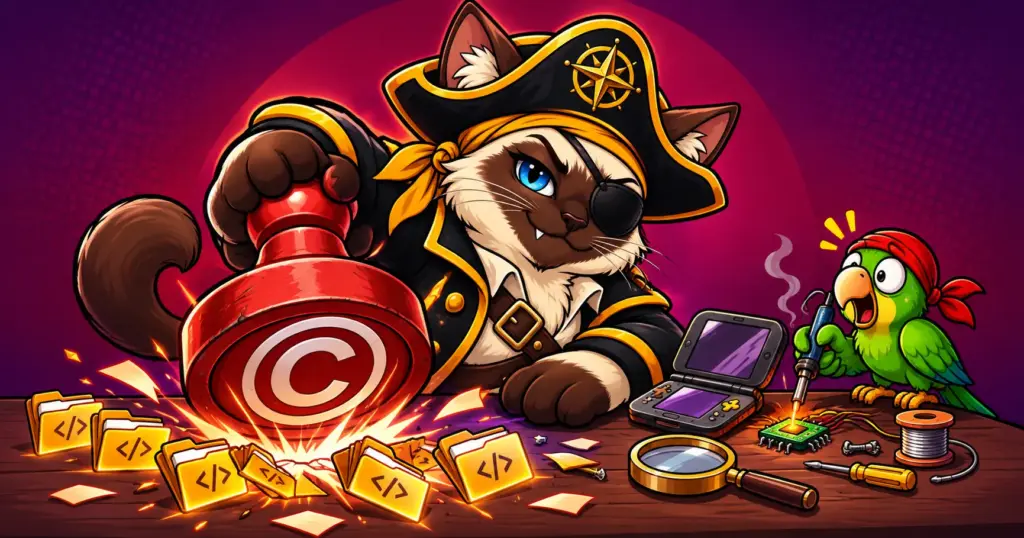
Nintendo of America has used a copyright takedown notice to remove open-source firmware for Nintendo Switch modchips from GitHub. The notice, dated 6 November 2026 and published in GitHub’s public DMCA archive this week, led the platform to disable a network of 144 repositories built around the Picofly project. According to TorrentFreak, it is the first time Nintendo has gone after modchip firmware on GitHub, rather than emulators or software tools.
What Nintendo targeted
The notice names a single parent repository that hosted documentation and firmware for Picofly, a low-cost Switch modchip based on the RP2040-Zero microcontroller board. Nintendo told GitHub that the entire repository was infringing and that all or most of its forks were too. GitHub therefore processed the request against the whole fork network: the parent project plus 143 copies.
Nintendo’s complaint is not about copied game code. It argues that the firmware lets modchips defeat the console’s technological protection measures, which the notice describes as including boot sequences and cryptographic signatures. The text says the firmware is meant for modchips “including but not limited to” four products:
- SX Core and SX Lite, the chips once sold by Team-Xecuter
- Picofly, the open-source RP2040-based design
- HWFLY, another third-party chip for the console
The legal basis is the anti-circumvention part of US copyright law. The notice cites 17 U.S.C. § 1201(a)(1) and (a)(2), which ban bypassing access controls and trafficking in tools built mainly for that purpose. To show it owns protected works, Nintendo listed copyright registrations for games such as Mario Kart 8 Deluxe, Animal Crossing: New Horizons, Super Smash Bros. Ultimate and The Legend of Zelda: Breath of the Wild.
The Team-Xecuter case in the background
To support its claim, Nintendo pointed to the US criminal case against Team-Xecuter, the group behind the SX Pro, SX Core and SX Lite chips. Three people were indicted in 2020. One of them, Gary Bowser, pleaded guilty to conspiracy charges linked to circumvention devices and received a 40-month prison sentence. The two other defendants, including the alleged leader Max Louarn, remain at large.
Video Games Chronicle points out that a guilty plea is not the same as a court ruling that modchips, or their firmware, are unlawful in every case. Nintendo does not need such a ruling to send a DMCA notice, though, and GitHub accepted this one. Some headlines have described the case as a trial win, but the sources describe only the earlier plea and sentence, not a new verdict.
The same day, Nintendo sent GitHub further notices. TorrentFreak reports that one hit a Citron Neo emulator network of 71 repositories, and two others targeted single repositories carrying yuzu code. Earlier in 2026, Nintendo had already removed hundreds of Switch emulator repositories from the platform in one sweep.
What it means for users
- Modded consoles keep working. A Switch that already has a chip installed is not changed by a takedown on GitHub. Tom’s Hardware notes that the main loss is easy access to firmware updates and reflashing files.
- Switch 2 is not affected. According to Tom’s Hardware, this modchip method does not work on the newer console.
- Mirrors and re-uploads are risky. When a popular open-source project disappears, unofficial copies tend to appear on file hosts and forums. Firmware is flashed directly onto hardware, so a tampered build from an unknown uploader can brick a console or carry unwanted code. Treat sudden “replacement” downloads with caution.
- Other repositories may follow. Projects that host similar firmware, forks or guides on mainstream platforms could receive the same kind of notice, so links shared in communities may stop working without warning.
What happens next
GitHub’s notice page explains that the repository owner can file a counter-notice if they believe the takedown was a mistake. When TorrentFreak checked, no counter-notice had appeared in the archive. Under the DMCA process, a counter-notice can lead to the code being restored unless Nintendo responds with legal action.
TorrentFreak also found that other Picofly and HWFLY firmware repositories, not named in the notice, were still online. That suggests further notices are possible if Nintendo decides to widen its campaign from software to hardware projects. The move fits a broader pattern in 2026, in which the company has relied on DMCA notices to platforms rather than lawsuits against individual developers.
For the homebrew and preservation community, the key question is whether open hardware documentation can stay on mainstream code platforms at all. For now, the answer on GitHub appears to be no whenever Nintendo files a notice.
Sources
- TorrentFreak: Nintendo Targets Picofly Switch Modchip Firmware in GitHub DMCA Takedown
- GitHub DMCA archive: Nintendo notice of 6 November 2026
- Video Games Chronicle: Nintendo’s battle against piracy continues with a DMCA takedown on Switch mod chip firmware
- Tom’s Hardware: Nintendo unleashes DMCA takedown wave against open-source Switch modchip firmware

 Android Apps
 Anime
 Download / DDL
 Forums & Community
 Streaming
 Torrent
 VPN