









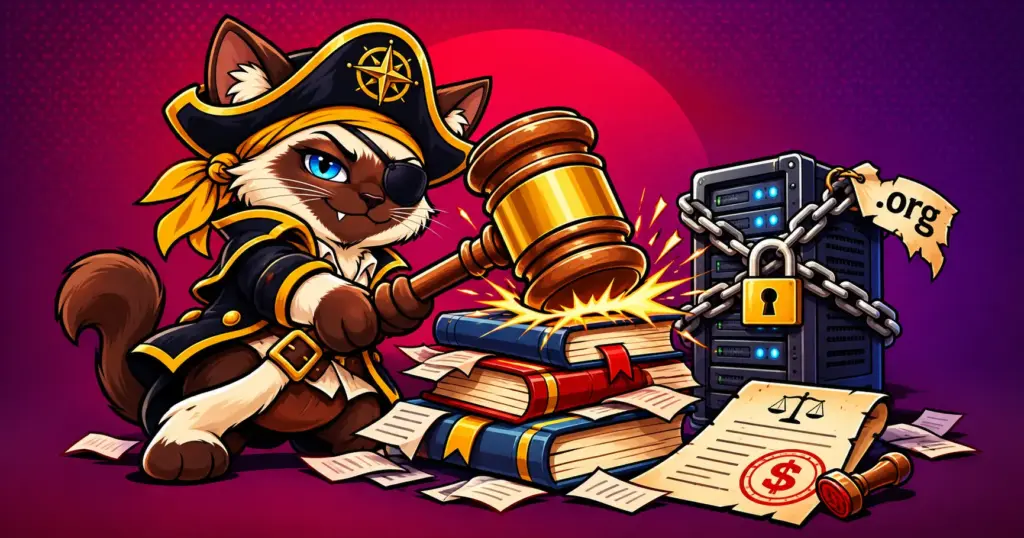
A federal judge in New York has ordered the anonymous operators of WeLib, a shadow library that offers millions of books and academic papers, to pay $19.5 million to thirteen of the largest publishers in the United States. The default judgment, signed by US District Judge Victor Marrero on 9 November 2026, also tells domain registries, registrars and hosting companies, including Cloudflare and Njalla, to take the site’s domains offline.
What the court decided
The case, Apress Media v. WeLib, was filed in the Southern District of New York on 16 June 2026. WeLib never appeared in court, the clerk entered a default in August, and the publishers asked for a final judgment on 12 October. Judge Marrero granted it, and according to TorrentFreak the signed order follows the text the publishers proposed word for word.
The damages are the highest the law allows. The court applied the $150,000 statutory maximum for willful infringement to each of the ten works that every publisher listed in the complaint:
- 10 works per publisher × $150,000 = $1.5 million per publisher
- 13 publishers × $1.5 million = $19.5 million in total
The plaintiffs include Penguin Random House, HarperCollins, Hachette Book Group, Simon & Schuster, Macmillan, Elsevier, Wiley, Pearson, McGraw Hill, Cengage, Taylor & Francis, Macmillan Learning and Apress.
Beyond the money, the order is a permanent, worldwide injunction. WeLib and anyone acting with it must stop distributing the publishers’ works, destroy unauthorised copies and, within ten business days of being served, file a sworn report that includes working contact details for the site and its managers.
Domains, Cloudflare and Njalla
The most practical part of the ruling targets the infrastructure. Every registry, registrar and hosting provider serving WeLib’s domains, including welib.org and welib.st, must disable them, lock them, switch off the nameservers and stop hosting the site. The order names Public Interest Registry, Cloudflare, Tucows and two Njalla companies, and it also covers any provider the site uses in the future. Those companies are also asked to preserve records that could help identify the people behind the site.
TorrentFreak noted one oddity: the injunction bans making the works available “including via BitTorrent”, although there is no known evidence that WeLib uses BitTorrent and the complaint does not mention it. The wording appears to come from the publishers’ earlier filing against Anna’s Archive.
Why WeLib was targeted
WeLib is a relatively new site. The publishers claim it was built using code and book files copied from Anna’s Archive, and it advertises around 43 million books and 98 million papers. In its June press release, the Association of American Publishers (AAP) described WeLib as a for-profit operation, pointing to paid plans that ranged from $7 to $90 per month for faster downloads, and cited reports that developers of large language models had used sites like it as sources of training data.
“WeLib steals, distributes, and profits from millions of literary, educational, and scientific works,” AAP President Maria A. Pallante said when the lawsuit was filed.
The result mirrors the publishers’ earlier case against Anna’s Archive, which ended with a default judgment in the same court on 19 May 2026, also with maximum statutory damages and an order aimed at domain and hosting providers.
What it means for users
For now, little has changed on the surface. When TorrentFreak reported on the ruling, welib.org and welib.st were still loading. That can change quickly once registries and Cloudflare act on the order, so users may see domains stop resolving without warning.
- Expect domain changes. Shadow libraries that lose a domain often reappear on new ones, as Anna’s Archive did. Each move also attracts copycat sites.
- Be careful with clones. Fake mirrors that copy a well-known name are a common source of malware, phishing pages and payment scams. This is a particular risk for a site that sold paid plans.
- Paid accounts are at risk. If the site is cut off, there is no guarantee that subscriptions or download credits will be honoured or refunded.
What happens next
The operators remain unidentified, so collecting $19.5 million looks unlikely. The real impact will depend on how quickly the named intermediaries comply and whether the site moves to registrars or hosts outside US reach. The order is written to cover future providers too, which gives the publishers a tool to pursue new domains without returning to court each time.
The publishers have now won two default judgments against shadow libraries in six months. Anna’s Archive is still reachable through alternative domains despite its ruling, so the WeLib case will show whether this approach can take a site offline for good or only pushes it from one domain to the next.
Sources
- TorrentFreak: Pirate Library WeLib Hit With $19.5m Default Judgment and Domain Takedown Order
- ChatGPT Is Eating the World: Judge Marrero grants default judgment to publishers v. WeLib
- The Bookseller: US court awards publishers $19.5m in WeLib piracy case
- Association of American Publishers: Publishers File Suit Against Pirate Site WeLib


 Android Apps
 Anime
 Download / DDL
 Forums & Community
 Streaming
 Torrent
 VPN